A Bridge to Somewhere: Walk Monumental
Last week my wife and I spent our Labor Day with a couple of good friends, as we walked across the Mackinac Bridge. Pronounced Mackinaw, or “Big Mac” if you’re a little more familiar, this 5-mile bridge connects the lower “Mitten” peninsula of Michigan with its Upper Peninsula (ahem, “U.P.”) neighbor to the north. When fully constructed, some 56 years ago, it was the longest suspension bridge in the world, maintaining that distinction for 41 years, until two more bridges – one in Denmark and the other in Japan – surpassed the Big Mac in 1998 by a few thousand feet. To this day, the Mackinac Bridge remains the third longest of its type in the world, and the longest in the Western Hemisphere.
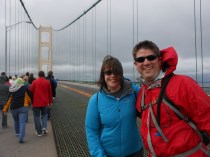
Yet somehow The Mighty Mac’s physical supremacy alone is not what makes its famous “Annual Bridge Walk” so popular, or powerful. Something else drives 40-80,000 people to cross its threshold, rain or shine, every year. For some, the motivation is supporting the bridge that literally changed the mobility and economy of an entire region. For others, it’s a subtle dare, a family tradition, a sense of community, or perhaps – for the lucky 400 runners selected by lottery – a chance to race out ahead of all the others (who must walk) for a personal race spanning water and time.
For Christian folk, the apostle Paul in his letter to the Hebrews, chapter 12:1, offers a glimpse into the traversing of trails and bridges over troubled waters in large numbers, posthumously of course (and way ahead of his time):
“Therefore, since we are surrounded by so great a cloud of witnesses, let us also lay aside every weight and the sin that clings so closely, and let us run with perseverance the race that is set before us…”
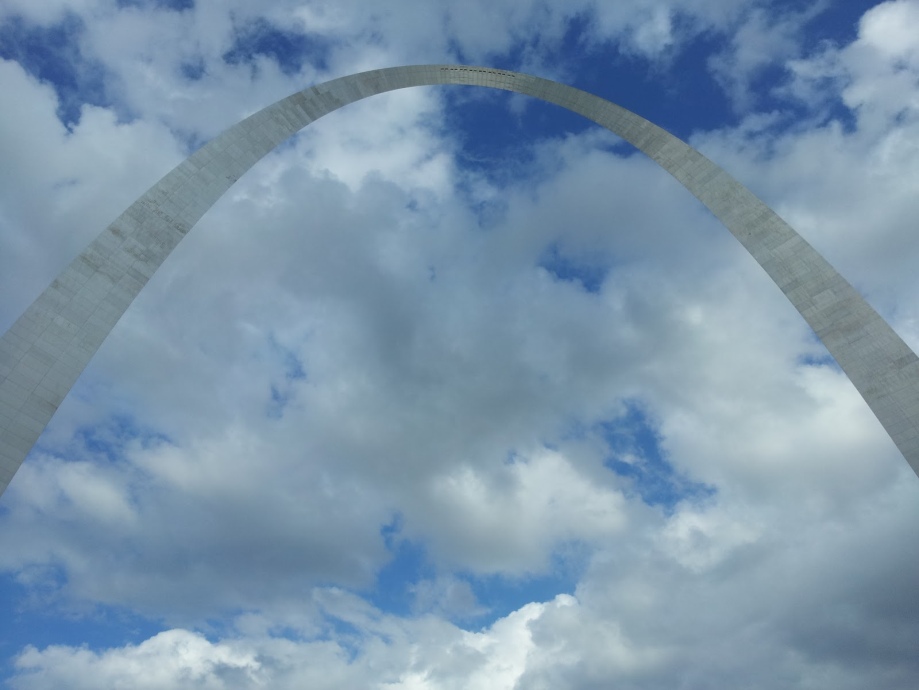
But for this traveler, there was one more characteristic that Big Mac shared with my own story, and my sense of sacred space: the stretched bond at a place in my mind where a Great Lake meets a Mighty River. Growing up in St. Louis, Missouri, USA, and along the banks of the Mississippi, I spent my childhood marveling over another bridge…The Gateway Arch, the largest bridge into the sky (and back) ever created, and my first connection to the Park Service and an ideal that would reshape my spirituality for years to come. Come to think of it, it still does.
What’s so special about the Arch? Well, for one, the “The Gateway to the West” is truly a monument in the purist sense. Yet it seems we humans in these parts have outgrown monuments either because of their lack of practicality, or because we’ve lost a key component of their importance: not to show our prowess (as our sense of vanity might suggest), but to boldly articulate the very act of dreaming itself.
I confess to watch the documentary, “Monument to the Dream” on a semi-regular basis. It’s only 28 minutes long and won an award or two for short film docs. But for reasons not entirely grasped, I pop it into my DVD player every few years or so. Perhaps I (re)view the film to remind myself of some of the Arch’s more impressive statistics: that it was the largest stainless steel construction project ever created; that it contains more steel than an aircraft carrier; or that it was built by hoisting a tailor-made train onto each of its legs, until its north and south partners could stand by themselves no longer and were “required” by the laws of physics to cooperate with astounding precision. The alignment margin for error of each triangular building block was amazingly slim: “The difference of 1/64th of an inch,” according to the film’s narrator, “could mean failure at the top.”
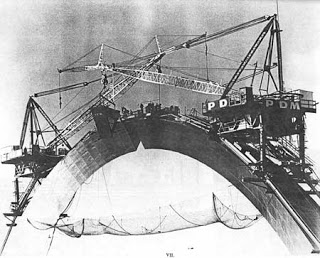
And the most amazing statistic of the Arch’s genesis, that other monumental bridges can scarcely boast, is that not a single worker died in its formation. Not even Big Mac’s construction story can top that stat.
What does all that mean? Maybe that’s not the right question. Maybe a better one is this: Where is the bridge training your eye to look? Up, down, ahead, or none of the above?…Cheers, travelers, to a bridge to somewhere…good.

