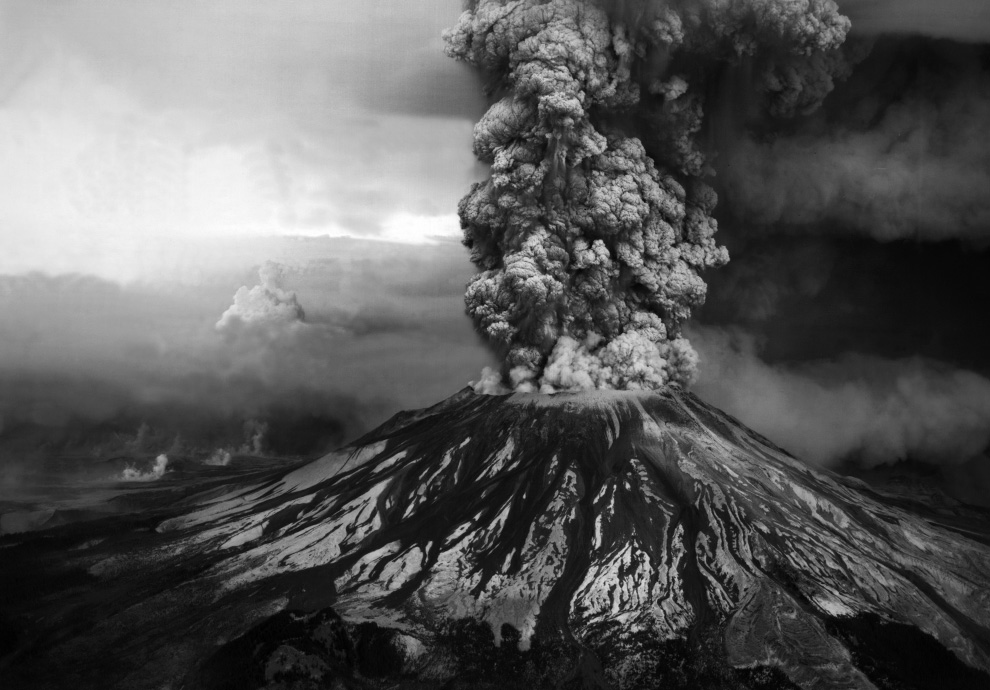
On May 18, 1980, at approximately 8:32 a.m. PDT, an entire mountaintop disappeared in minutes as the “deadliest and most economically destructive volcanic event in the history of the United States” occurred. The volcano was Mt. St. Helens, and its path of destruction was so vast, and so terrible, that it left a crater 2 miles wide and 1,300 feet deep, leveled miles of trees, roads, railroads and buildings…In the end, its human death toll reached 57, and scientists speculate that as many as 7,000 big game animals were killed along with an incalculable loss of life for virtually everything else the eruption touched…a devastation area that by some calculations reached nearly 250 miles in diameter.
The one thing I remember asking as a child was, “How could that happen?”, and the one question I ponder 33 years later is this: “How much worse would it be if St. Helens were located near Manhattan NYC, Los Angeles, CA — or really anywhere with a population much greater than that sparsely populated area in Washington state, along that fiercely beautiful Cascade Mountain range.
On September 11, 2001, at approximately 8:46 and 9:03 a.m EDT respectively, two commercial airliners plunged into the World Trade Center towers of New York City, USA, resulting in their implosion and horrific loss of life. Debris billowed from their ruin for miles, as people around planet earth witnessed on live television an eruption originating from a place uglier even than blasting magma and clouds of soot. All told, the “9-11” attacks that day in New York, Washington D.C., and Pennsylvania resulted in nearly 3,000 deaths. More than 90 countries lost citizens, and a new crater was formed in what once was a veritable mountain. Somewhere it was felt. Or more accurately, Everywhere. And the human landscape was changed forever.
A benevolent storyteller might end such an account with a question instead of a judgment. “Where were you that day?” they might ask, or “What were you doing when it happened?” On occasion, however, the narrator will sink into the smoldering rubble of 911’s terror, as the mood changes to raw revenge, perpetual war-mongering or a sadness laced with some unidentified subterranean emotion. Perhaps the words “Never forget…” bubble to the surface, and cheeks fill with lava.
Indeed I am all for remembering that day, grieving it, and – yes, even somehow learning from it. But for some reason, my mind’s eye pans cross-country to a different Washington as I hear St. Helens posing a new question: “How is (God) transforming you at the edge of the crater?”
My favorite volcano picture to-date is this borrowed one from a Wikipedia link on my way to the National Geographic website, showing the crater of Mt. St. Helens decades later – an immense gap whose center-point trains our eyes to the heavens surrounding the peak’s ghost, daring the mountaineers standing along her edges to be transformed:

And then I think of this verse from an apostle written millennia before: “38 For I am convinced that neither death nor life, neither angels nor demons,[a] neither the present nor the future, nor any powers, 39 neither height nor depth, nor anything else in all creation, will be able to separate us from the love of God…” (Romans 8:38-39a)
I take away that nothing can replace the crater. And I don’t pretend to comprehend…But perhaps the years will tell us at anniversaries like the ones two weeks ago, this: we can only trust the mystery and pray for a peace beyond our understanding, boldly perched at the edge of somewhere, in a Creation that is far from finished.
So long, Old St. Helens…A new topography awaits.
 trailversecity
Beautiful post. I like this verse from Romans a lot.